Read Flic's new book before anyone else
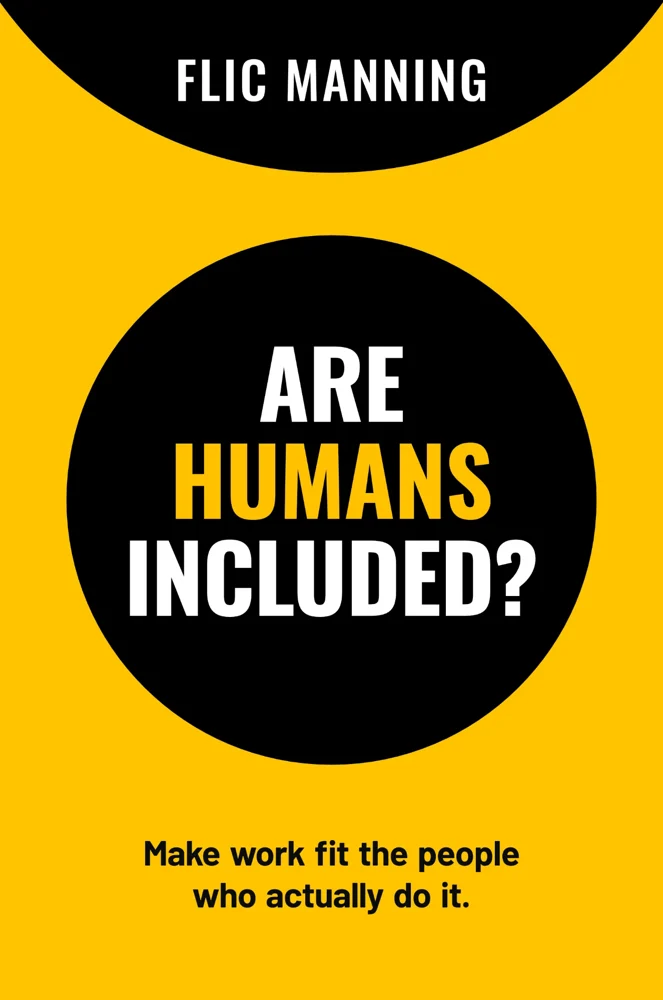
Are Humans Included? is for anyone who's had to bend to fit their work. Join for a free copy before release.
We won't send you spam. Unsubscribe at any time.About the book
In Silicon Valley, surrounded by people who wore exhaustion as a badge of honour, Flic Manning discovered that working harder didn't always mean working better. Living with chronic illness made the consequences impossible to ignore. But what if the problem wasn't her ability to keep up? What if it was the way the work had been designed?
Are Humans Included? challenges the assumptions we've built into modern working life, from the myth of the average employee to the belief that being busy means being productive. Drawing on personal experiences, research and practical examples, Manning explores how we can build workplaces that account for real human capacity, without lowering standards or sacrificing results.
And as artificial intelligence reshapes how we work, the question becomes more important than ever.
What if, instead of constantly trying to change people to fit the work, we started designing work to fit the people?
Prelude: Are Humans Included?
Prelude
The harder I worked, the worse I became at my job.
It’s a strange thing to admit when so many of us are taught that hard work is the foundation of success. But that’s exactly what happened to me, and it took far longer than it should have to recognise why.
I was working in Silicon Valley, surrounded by founders and developers building things that hadn’t existed before. The ambition was infectious and the ideas were enormous. I wanted to be part of it. More importantly, I wanted to be good at it.
Everyone seemed to know what success required. You worked long hours. You made yourself available. You moved quickly, took on more responsibility and found ways to squeeze another task into an already crowded day. Being busy was almost a form of professional credibility. People spoke proudly about how little sleep they’d had, how many projects they were juggling or how much they’d managed to accomplish over a weekend. Exhaustion wasn’t treated as a warning sign. If anything, it was taken as evidence that you were doing something right.
An office might officially open at eight and close at five, but those weren’t the hours anyone worked. Ten or twelve hours at a desk were often followed by a few more at home, and a weekend mostly meant doing the same work from a different chair. Even the parties weren’t a break. While one was in full swing, you could find a room of developers still coding. Someone in one corner would be worried about making payroll that week, and someone in another would be celebrating a ten-million-dollar investment. Unless they told you, it was hard to tell which was which. Whichever it was, the answer was the same. You kept working.
And I bought into it. Completely. I was ambitious, determined and surrounded by people who appeared to be succeeding by working at an extraordinary pace. Why wouldn’t I follow their example? When everyone around you is doing something, you begin to assume that’s simply how success works. You look at the people achieving the things you want to achieve, and you imitate the behaviour you believe is getting them there.
There was one complication. I was living with chronic illness and disability, and my body wasn’t particularly interested in the expectations of startup culture. I could push myself, certainly, but the consequences didn’t disappear because I had another deadline to meet. The harder I worked, the more my symptoms intensified. Fatigue became overwhelming, my pain increased, and my ability to concentrate deteriorated. I began making mistakes that took additional time and effort to correct. Tasks that should have been straightforward became increasingly difficult, not because I didn’t understand them, but because I was trying to complete them while running on empty.
My response was to work harder. I tried to compensate for mistakes by putting in more effort. When my concentration suffered, I pushed myself to focus. When something took longer than expected, I gave it more time. I was trying to put out a fire by adding fuel. The result was a cycle in which I was working more, recovering less and becoming progressively less effective at the work I cared about doing well.
What made this difficult to recognise was that the behaviour looked right. I was committed. I was putting in the hours. I was doing what the surrounding culture encouraged me to do. Measured by effort, I looked very dedicated indeed. But if they measured the quality of my attention, the additional work created by mistakes or what it was costing me to maintain that pace, they would have seen a very different picture.
Eventually, I had to confront the possibility that my understanding of productivity was fundamentally wrong. My ambition was fine. My work ethic was fine. Effort just has limits, and pushing past them can undo the very results you’re chasing. I had gone well past mine, and every extra hour I added was making things worse, not better.
That experience changed the questions I asked about work. Instead of automatically looking for ways to become more efficient, disciplined or resilient, I became interested in the conditions that made so much effort necessary in the first place. I wanted to understand why we organised work around expectations that weren’t always compatible with the people expected to meet them, and why the consequences were so often treated as individual failures.
We were remarkably good at designing businesses, technologies and processes around what they needed to achieve. We planned for demand, considered resources, managed dependencies and looked for ways to make the results more reliable. Yet with the humans doing the work, we simply assumed they would stretch to fit.
Somewhere along the way, we had started looking at people upside down. The work was the fixed point: the hours, the targets, the pace. The person was the part expected to bend around it, and when they couldn’t, the person was what we set out to fix, with more resilience, more discipline and a better morning routine. This book turns that picture the right way up. It starts with the human who actually turns up to work, with a body, a mind, a life and a capacity that changes from one day to the next, and asks what the work would look like if it were built to fit them.
That isn’t a story with villains in it. The people who design work are human too: the manager setting the targets, the leader signing off the budget, the founder writing next week’s roster at eleven at night. Most of them are running on the same assumptions as everyone else, and paying for them in the same ways. If someone has handed you this book, take it as an invitation. You’re both human. The work should be built for both of you.
All of this matters more now, because work is being redesigned again. This time it’s being rebuilt around artificial intelligence: tools that can draft, sort, summarise and respond at a speed no person can match, at any hour, without needing a break, a weekend or a quiet word of encouragement. Organisations everywhere are deciding which tasks to hand over, which roles to reshape and how quickly everyone else should adapt.
Some people find this exciting; others find it frightening, and many feel both. I spent years around people building technology that changed how the world operated, and I saw how far those changes reached beyond the products themselves: into how people earned a living, how communities worked and what came to be seen as normal. This shift is moving faster than the internet did, and it looks set to reach further still. I won’t pretend to know where it ends. What I do recognise is the pattern. Once again, we’re planning carefully for what the technology needs: the data, the infrastructure, the investment, the rollout. And once again, the people expected to work alongside it risk being treated as the part that will adjust on its own.
If the pace of work was hard to keep up with when it was set by the busiest person in the room, what happens when it’s set by something that never gets tired? Who decides which parts of a job stay human? And who is in the room when those decisions are made?
This isn’t a book about technology. It’s a book about how work is designed and who it’s designed for, written at a moment when a great deal of that design is up for grabs. Along the way, I’ll take some of the parts of working life most of us have stopped questioning and turn them over, to see what they assume about the people inside them. There are small experiments to try as you go, because the only way to know whether any of this holds for you is to test it.
I came home from the Valley with a question I still haven’t been able to put down.
In all our efforts to design better ways of working, had we remembered to include the humans?
FAQ
- When is the book coming out?
- Are Humans Included? will arrive Q1 2027.
- What formats will it be in?
- Ebook and Paperback in Q1. The Audiobook will arrive in Q2/Q3 2027.
- Where will I be able to buy it?
- On Amazon at launch. Audiobook TBA.
- Do I have to write a review to get a free copy?
- No. The free copy never depends on a review. If you choose to write one, an honest one is all we'd hope for.
- What other books has Flic written?
- Her debut memoir Living Human: Sustainable Strategies for Invisible Illness was published in 2021.